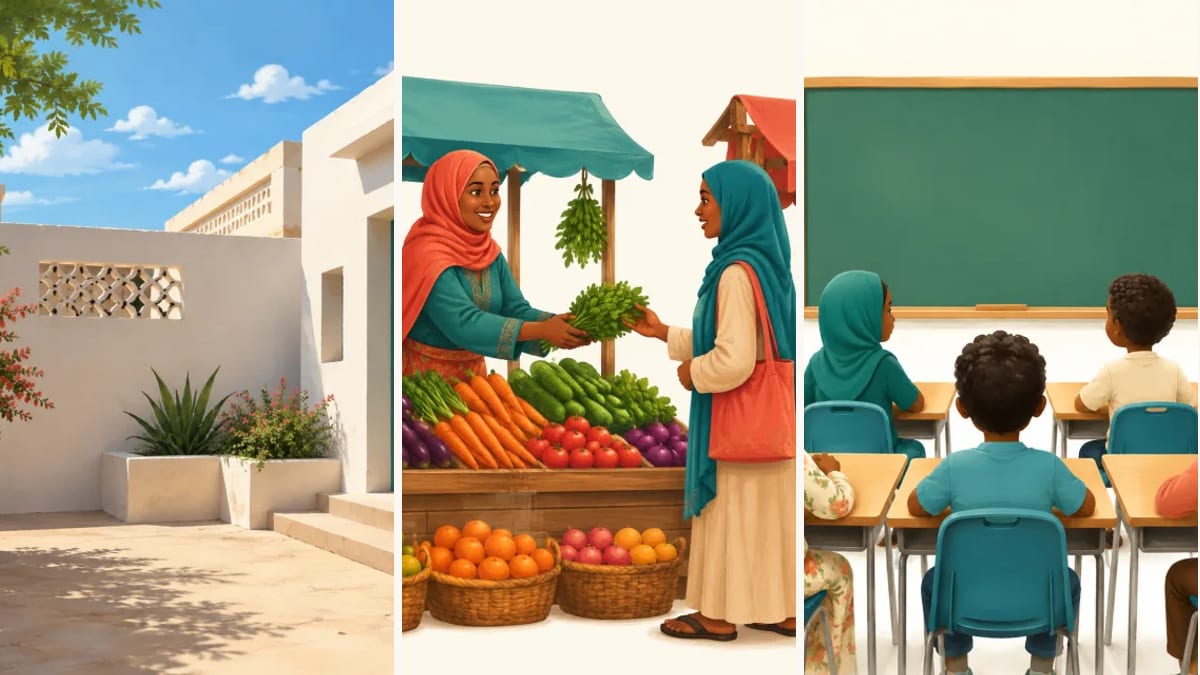
Children ask questions their parents never had to think about. Where does Somali come from? How many people speak it? Why do we write it with English letters? Here are the answers, checked and kept short, so that the next time your child asks, you have them ready.
Where Somali is spoken
Somali is the language of the Somali people of the Horn of Africa. It is the official language of Somalia and Somaliland, and it is spoken across the wider region: in Djibouti, in the Somali Region of Ethiopia, and in northeastern Kenya. Draw a line around those places and you have the Somali-speaking homeland, a large territory where one language is spoken from the coast to the interior.
Then there is the diaspora. Somali is spoken in homes in Minneapolis, London, Toronto, Stockholm, Oslo, Melbourne and dozens of other cities, as well as in the Gulf states and in East Africa beyond the homeland. If you are reading this, you probably live in one of those places, and your child is one of the reasons the map keeps growing.
How many people speak it
Estimates vary, and censuses across the region are old or incomplete, so nobody can give you an exact figure. The common estimate is roughly 20 million speakers or more worldwide. That makes Somali one of the larger languages of Africa and one of the largest in its branch of the family.
That branch is Cushitic. Somali belongs to the Cushitic branch of the Afroasiatic family, and its closest relatives are languages such as Oromo and Afar. Arabic, Hebrew and Amharic are in the same family but in the Semitic branch, which is why Somali and Arabic share a family resemblance in some sounds without being mutually understandable. The Arabic words in Somali, and there are many, arrived through religion, trade and schooling, not through common ancestry. Macalin (teacher) and qalin (pen) are two your child will meet early.
An alphabet younger than your parents
For most of its history Somali was a spoken language with no single agreed way to write it. Religious scholars wrote it in Arabic script, and in the twentieth century several Somalis invented scripts of their own, the best known being Osmanya. None became official or widely taught.
That changed in 1972, when the Somali government adopted the Latin alphabet as the official script and followed it with nationwide literacy campaigns. So the alphabet your child learns is younger than many of their grandparents. Ayeeyo (grandmother) may have learned to read Somali as an adult, or not at all, which is worth remembering when she asks your child to read something to her.
The 1972 alphabet was designed for Somali rather than adapted from another language, which is why it fits so well. It has 21 consonants and 5 vowels. You can hear every one of them, recorded by a native speaker, on the Alphabet page.
Written the way it sounds
Somali spelling is almost completely phonetic. Each letter has one sound and each sound has one letter. There is no silent e, no “ough” with five pronunciations, no guessing. Once a child knows the letters, they can read canjeero (the spongy fermented flatbread eaten at breakfast) and libaax (lion) correctly the first time, even if they have never seen the words.
Two features of the spelling do the heavy lifting. Long vowels are written twice: hooyo (mother), aabo (father), buug (book). Doubled consonants are written twice too: saddex (three), toddoba (seven), siddeed (eight). Both kinds of doubling change meaning, so the spelling is telling you something real, not decorating the word.
Three letters have no English equivalent. The letter c is a deep sound from the throat, as in cun (eat) and caano (milk). The letter x is a breathy h, as in madax (head) and lix (six). The letter q comes from the back of the mouth, as in qorrax (sun) and qabow (cold). Two more, dh and kh, are single sounds written with two letters, as in dhag (ear).
And three English letters are missing entirely. Somali has no p, v or z, so borrowed words change shape to fit: police becomes booliis, television becomes telefishin. Children find this funny, and it is a useful way to show them that Somali has its own rules rather than borrowed ones.
A language of poets
Somalis are often described as a nation of poets, and it is not an exaggeration. For centuries the highest art form was spoken, not written: long, formal poems composed in the head, memorized, and carried from town to town by reciters. The classic genre is the gabay, a long-line poem on serious subjects, and the buraanbur is the form traditionally composed and performed by women.
The rules are strict. Every line of a poem must contain the same alliterating sound, from the first line to the last, on top of a fixed rhythm. A poet who begins with the sound of g must find a g word for every line of a poem that may run to a hundred lines. This tradition is one reason Somali speakers care so much about how a word sounds, and one reason grandparents will correct a child’s vowel length without hesitation. The sound is the point.
The little words that carry the sentence
Somali sentences are put together differently from English. The verb usually comes last: Biyo i sii (give me water) is literally “water me give”. Children are not bothered by this at all. It is adults who find it strange.
The other thing to know is a set of small words that English does not have. Waa introduces a plain statement: Hooyo waa macalin (Mother is a teacher). Baa and ayaa put the spotlight on the word before them: Hooyo baa timid or Hooyo ayaa timid (it was Mother who came). Linguists call these focus markers. You do not need the term. You need to know that they let Somali move words around for emphasis in a way English does with the voice, and that a child who hears enough Somali picks them up without being taught.
Why it is easier to learn than you think
Put the facts together and Somali looks less daunting than its reputation.
| What worries parents | What is actually true |
|---|---|
| It is a completely different alphabet | It is the Latin alphabet, spelled the way it sounds |
| The sounds are impossible for kids | Three new consonants, which children copy easily from a native voice |
| The grammar is exotic | A few patterns, such as waan + adjective + ahay, cover most everyday sentences |
| There are no resources | Family, the spoken tradition, and now tools built for diaspora children |
The spelling is the biggest gift. A child who learns to read Somali does not face years of exceptions. The sounds are learnable by copying, which is why native audio matters so much for children who do not hear Somali all day. And the vocabulary a child needs at home, around 250 words and phrases for family, food, the house, feelings and greetings, is a manageable amount. You can browse all of it in the dictionary on this site, organized by topic.
What has been missing for diaspora families is not the language. It is material made for children, in the standard variety, with real voices. The big language apps do not teach Somali at all, and the few that do are built for adult travelers, a gap we cover in detail on the alternatives page. Somali itself has never been the problem.
Frequently asked questions
How many people speak Somali?
Estimates vary, but Somali has roughly 20 million or more speakers worldwide. Most live in the Horn of Africa, with large diaspora communities in Europe, North America, the Gulf and Australia.
When did Somali get a written alphabet?
Somali was written in several scripts before 1972, but the Latin alphabet became the official script in 1972. Because the spelling was designed for the language, it matches the sounds very closely.
Is Somali related to Arabic?
Both belong to the Afroasiatic family, but Somali is Cushitic while Arabic is Semitic, so they are distant cousins rather than siblings. Somali has borrowed many words from Arabic, especially for religion, school and trade.
Try Luuqad with your child tonight
Ten minutes. Real voices. 4.6 stars on the App Store.
Written by Luuqad team. The people who make Luuqad. Illustrations from the Luuqad app.