
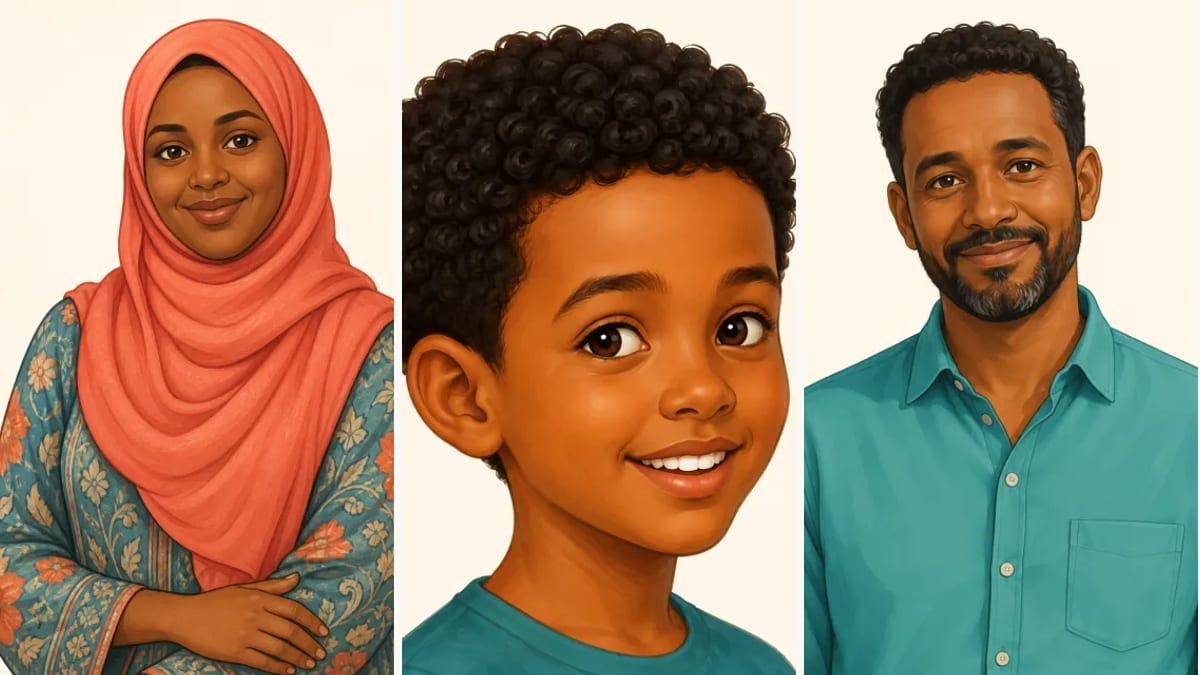
Every Somali parent abroad knows the moment. You say something in Somali, your child answers in English, and you wonder whether the language will survive another generation in your house. It can, and the families who manage it are not doing anything heroic: they repeat a few small habits until the habits become the way the house works.
1. Pick one Somali-only moment a day
You do not need a Somali-only home. Most diaspora families cannot manage that, and trying and failing is worse than not trying, because everyone ends up feeling guilty. What works is one moment a day that is always, without exception, in Somali.
Choose a moment that already repeats itself. Breakfast is a good one, because the words are the same every morning: canjeero (the spongy fermented flatbread eaten at breakfast), shaah (tea), caano (milk), biyo (water). Getting dressed is another: kabo (shoes), shaati (shirt), jaakad (jacket). The Clothing topic lists the ten words most families need, each with a recording you can play while you hold up the item.
The rule is simple. During that moment you speak Somali and only Somali. You do not translate, you do not switch when they look confused, and you do not make it long. Ten minutes is plenty. Within a few weeks the child knows what is coming and starts to meet you there.
2. Answer in Somali even when they ask in English
This is the habit parents say made the biggest difference, and it is also the hardest. Your child asks in English. You are tired. It is faster to answer in English. Every time you do, you teach them that Somali is optional.
Answering in Somali does not mean pretending you did not understand. You heard the question. You simply reply in Somali, at a level they can follow, and carry on. If they ask for milk, you pour it and say Caano ma rabtaa? (do you want milk?) as you do. If they ask where their shirt is, you hold it up and say Kani waa shaatigaaga (this is your shirt).
Over time the child starts to answer in Somali because the words are already in the air. A child who understands Somali but speaks English is halfway there, not failing, and we explain why in What to do when your child answers you in English.
Word to know: hooyo means mother, but it is also what a Somali mother calls her own child. When you say hooyo to your daughter you are using the word exactly as generations before you did. It is usually the first Somali word a diaspora child says and the last one they forget.
3. Let grandparents be the teachers
Ayeeyo (grandmother) and awoowe (grandfather) have something you do not have. They cannot switch to English, or they will not. A child on a video call with ayeeyo has to find the Somali words, because the alternative is silence, and children do not like silence.
Make the call a fixed part of the week, and make it the child’s call rather than yours. Give them a job before it starts. This week, tell ayeeyo what you ate. Next week, count your toys for awoowe. Hand them two phrases to open with, Subax wanaagsan (good morning) and Iska warran (how are you?), and let the rest happen. It will be slow. Let it be slow.
Grandparents also carry the words that apps and books tend to miss. The names of relatives, for a start: adeer (your father’s brother), abti (your mother’s brother), eedo (your father’s sister), habaryar (your mother’s sister). English flattens all four into uncle and aunt. A grandmother will not, and she will be pleased when the child gets it right. The Family topic has all ten family words with audio if you want to practice before the call.
If grandparents live in the same city, even better. A Saturday at ayeeyo’s house is worth more than a Saturday of worksheets.
4. Make it a game, not a lesson
Children do not learn a language because they are told it is important. They learn it because something they want is on the other side of it. Lessons feel like school. Games feel like play, and play is where children take risks with words.
Some games cost nothing. Hide a toy and give directions in Somali. Play a version of Simon says with body parts: touch your san (nose), lift your gacan (hand), stamp your cag (foot). Count the stairs every time you climb them, kow, laba, saddex (one, two, three), until the child takes over the counting.
Apps can help here if they are built for children rather than for adult travelers. In the Luuqad Play tab, the Baadiyo Journey game sends a child on a trip to the baadiyo (countryside). They pack for the journey, then have to find biyo and other things by name as the story unfolds. The child is not studying the word for water. They are looking for water, which is a different thing entirely. There are twelve games in the tab, and the games page shows what each one teaches.
Whatever game you choose, let the child win often. The goal is that they connect Somali with the feeling of being good at something.
5. Celebrate small wins loudly
Somali culture is generous with praise for children, and this is the place to spend it. The first time your son says mahadsanid (thank you) without being prompted, stop what you are doing and tell him you heard it. Call aabo (father) in. Tell ayeeyo on the next call, with the child listening.
Small wins are the whole game. A full sentence in Somali is built from single words that were each, once, a small win. A child who is praised for one word will try two. A child who is corrected for one word will try none.
Keep a record somewhere visible. Some families put a chart on the fridge and add a word each time a new one is used unprompted. Others keep a note on their phone and read it to the child at the end of the month. The method does not matter. What matters is that the child sees the list growing and knows you see it too.
Start with one
Five habits is a lot to start on a Tuesday. Pick the one that fits your house most easily, usually the daily Somali-only moment, and do only that for a month. When it feels normal, add the next.
None of this requires you to be a perfect Somali speaker yourself. Parents who feel their own Somali is rusty often worry they will pass on mistakes. You will pass on far more than mistakes. You will pass on the sound of the language, the family words, and the idea that Somali belongs in your child’s mouth as much as English does. The parents page collects everything on this site written for families, if you want somewhere to go next.
Frequently asked questions
Can a child still learn Somali if they only hear English at school?
Yes. School gives them English all day, so the goal at home is to make Somali the language of specific repeated moments such as meals, bedtime and calls with grandparents, where consistency matters more than total hours.
Is it too late to start speaking Somali to a child who is already seven or eight?
No. Older children pick up vocabulary quickly because they can ask questions and notice patterns, so start with one daily routine in Somali and add more as it becomes normal.
Should I correct my child's Somali mistakes?
Repeat the sentence back correctly and keep the conversation going rather than stopping to correct. Children fix their own mistakes when they hear the right form often enough.
Try Luuqad with your child tonight
Ten minutes. Real voices. 4.6 stars on the App Store.
Written by Hodan Warsame. Writes about raising bilingual children in the diaspora. Illustrations from the Luuqad app.