
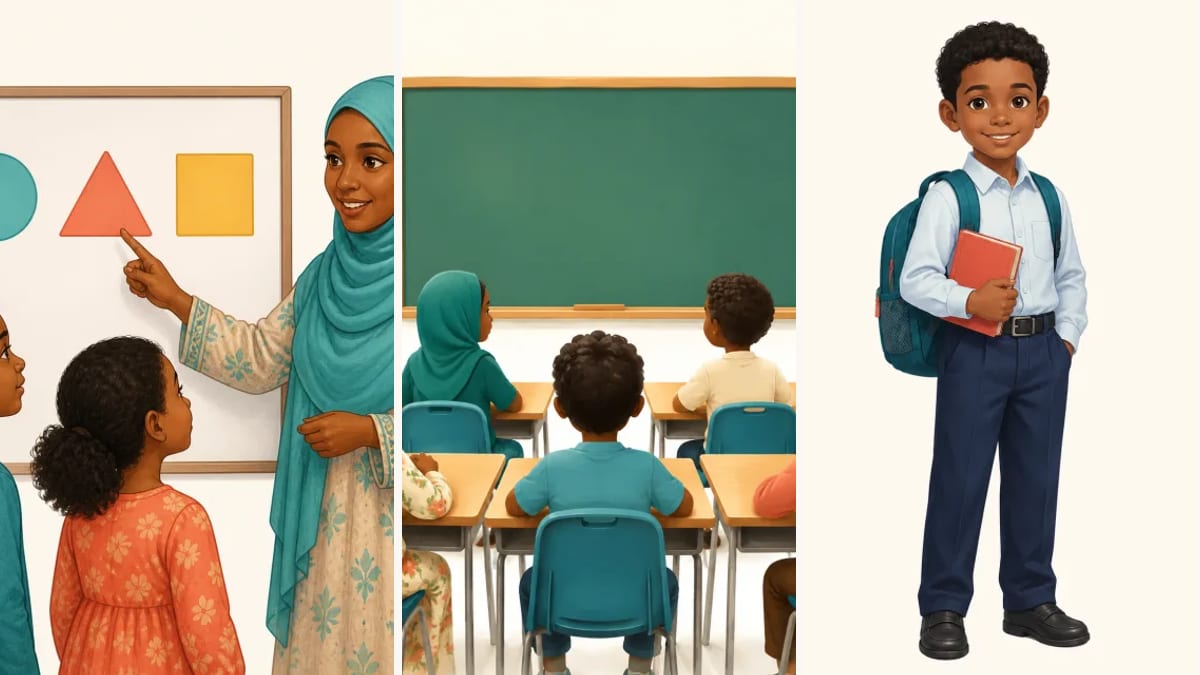
Most weekend Somali schools run on goodwill: a rented hall, a few volunteer teachers, and a room full of children who have already sat through five days of school. The hard part is not the Somali. It is holding the attention of thirty tired kids for ninety minutes, and the answer is a plan that changes activity every ten to twenty minutes and repeats the same shape every week.
The 90-minute plan at a glance
Children relax when they know what comes next. If every class starts with the alphabet and ends with a song, the room settles faster and you spend your energy on teaching rather than on managing. Only the ten new words change from week to week, whether your class is a stand-alone Somali school or the language hour inside a weekend dugsi (the Somali or Qur’an school many diaspora families attend).
Timings are a guide: if the game is going well, let it run and shorten the quiz.
| Time | Activity | Materials |
|---|---|---|
| 0:00–0:10 | Arrival and greeting circle | Name cards, chairs in a circle |
| 0:10–0:20 | Alphabet warm-up | Phone or tablet with a speaker, letter cards |
| 0:20–0:25 | Counting warm-up | Nothing (hands for clapping) |
| 0:25–0:45 | Ten new words from one topic | Picture cards, whiteboard, the app’s audio |
| 0:45–0:55 | Movement game (no screen) | Space to stand and move |
| 0:55–1:05 | Snack and break | Water, fruit, or whatever families send |
| 1:05–1:20 | Quiz and review | Paper quiz for older children, shared screen for younger ones |
| 1:20–1:27 | Song or chant | Nothing |
| 1:27–1:30 | Homework and goodbye | Homework slip for parents |
If you only have sixty minutes, shorten everything except the game. It is the part children remember on Monday.
Warm-up: the alphabet and the numbers (15 minutes)
Start the class in Somali before anyone has a chance to drift. Greet each child with Subax wanaagsan (good morning) and wait for the reply. Then go round the circle with Iska warran (how are you?) and the answer Waan fiicanahay (I am fine).
The alphabet comes next. Somali uses the Latin alphabet with 21 consonants and five vowels, and it is almost perfectly phonetic: one letter, one sound. Play the letters from the Alphabet topic in Luuqad through a speaker and have the whole class repeat after the native speaker. You do not need all 21 letters every week. Pick five, and always include the ones that trip up children raised on English: C, X, Q, DH and KH. The alphabet pages on this site have the same audio if you are preparing at home.
Then count. Stand up, clap once per number, and go from kow (one) to toban (ten). Once the children are confident, go on to kow iyo toban (eleven, literally “one and ten”) and up to labaatan (twenty). The Numbers topic in the app is a good model for the rhythm, and the regular pattern from eleven onward means the older children can teach it to the younger ones.
Ten new words from one topic (20 minutes)
Ten words a week is the right number. Fewer and the older children get bored; more and the younger ones lose the first five while you teach the last five. Stay inside one topic per week, because words from the same topic hold each other up.
Take Face & Body as an example. The ten words are madax (head), waji (face), il (eye), dhag (ear), san (nose), af (mouth), gacan (hand), far (finger), lug (leg) and cag (foot). All fifteen body words are on the Face & Body page with audio.
The routine for each word is the same:
- Show the picture card and say the word once yourself.
- Play the native recording and have the class repeat it twice.
- Point to the body part on yourself and have everyone point to their own.
- Say the word again and let the children point without you.
After the ten words, put the children in pairs: one says a word, the other points. Stop before they are tired of it.
Over a term, rotate through topics children can use at home: Family, Colors, Animals, Food, House and Clothing all work well.
A game that needs no screen (10 minutes)
This is Somali Simon says, and the twist is that the trigger word is fadlan (please). Children obey a command only when it begins with fadlan. If you give the command without it, anyone who moves does a silly penalty (a spin, a hop on one leg) and stays in the game. Elimination leaves the youngest children sitting out for most of the fun, so keep everyone playing.
The commands use the body words from earlier:
- Fadlan, taabo madaxa (please touch your head)
- Fadlan, taabo gacanta (please touch your hand)
- Fadlan, taabo cagta (please touch your foot)
- Fadlan, taabo sanka (please touch your nose)
- Fadlan, taabo dhagta (please touch your ear)
Start slowly, then speed up. After a few rounds, hand the leader’s job to an older child. Leading is the best speaking practice in the class.
One more game that needs nothing but the room: line the children up, count kow, laba, saddex (one, two, three) and call orod (run). Whoever starts before orod goes back to the line.
Break, quiz, and homework the app can mark (25 minutes)
Give the children ten minutes to eat and talk, and say biyo (water) as you hand out the bottles. That is a word taught without a lesson.
After the break, run the quiz. For children who can write, a paper quiz with ten pictures and a blank line under each is enough. For the younger group, put the Face & Body quiz from the Answer tab on a shared screen and let them take turns tapping the answer while the rest of the class shouts advice.
Then set the homework. Ask families to open the same Answer quiz at home and try to beat the class score. The app tracks the best score for each topic, and the Leaderboard tab shows XP and day streaks, so children who play at home come back wanting to show you. The app also has twelve games, and Listen and Tap or Word Match make a good second homework for children who finish the quiz quickly.
Be clear with families about what the app is: free to download on iPhone and iPad, with a Premium subscription for the full set of lessons, quizzes and games, and no Android version yet. Children without the app do the paper quiz at home, and nobody should feel left out because of a phone.
End with a song and a goodbye (10 minutes)
Do not invent a song. Use one the children already know from home, or build a chant from the numbers: count to ten with a clap, count down with a stamp, then do it faster. Children who will not speak in front of the class will sing with it.
Finish standing in the circle. Say Nabadgelyo (goodbye) and Is arag danbe (see you later), and wait until every child has said it back. Hand parents the homework slip at the door.
Teaching a room of mixed ages
Most Saturday schools have one room for everyone from five to twelve, so plan for it rather than fighting it.
- Seat in pairs, older with younger. The older child explains, the younger one copies, and both practice.
- Give every task three levels. Younger children point to the picture, middle children say the word, older children write it. Same word, same moment, three jobs.
- Make the older children helpers. Call them macalin yar (little teacher). A ten-year-old who leads the game is learning more than one who sits at the back.
- Keep the ten words for everyone. Do not give the older children a separate list. Give them harder ways to use the same list, such as a sentence like Kani waa madax (this is a head).
The teachers page has more on fitting the app’s topics to a term of weekly classes.
Keeping parents in the loop
The class is ninety minutes a week. Home is the other six days, and parents who know the ten words will use them. Send one message after every class, in whatever group the school already uses, and keep it to four lines:
This week: Face & Body. Words: madax, waji, il, dhag, san, af, gacan, far, lug, cag. Homework: the Face & Body quiz in the Answer tab, or the paper quiz. Try this at home: Fadlan, taabo sanka (please touch your nose).
Give parents the exact words, in the spelling you taught, so the child hears one version. Give them one sentence to say, so it happens at dinner without planning. And say what the class is for: a child who does ninety minutes a week will not be fluent by the end of term, but they will greet ayeeyo (grandmother) on the video call, count the stairs and name the parts of their face in Somali, and that is a real start.
Once a term, invite an ayeeyo to sit in the circle and let the children greet her in Somali. No lesson you can plan motivates a child as much as making an elder smile.
Frequently asked questions
How long should a Saturday Somali class be for children?
Ninety minutes works well for ages five to twelve if the activity changes every ten to twenty minutes and there is a break in the middle. Younger children need more movement and shorter word lists.
How many new Somali words should children learn in one class?
Ten words from a single topic is enough for most weekend classes. Children keep the words when they hear native audio, say them aloud several times and use them in a game the same day.
Do I need a device for every child?
No. One phone or tablet connected to a speaker is enough to play native audio to the whole class. The quiz can be done together on a shared screen, and children who have the app at home can do it as homework.
Try Luuqad with your child tonight
Ten minutes. Real voices. 4.6 stars on the App Store.
Written by Mohamed Abdi. Writes about teaching Somali in weekend and Saturday schools. Illustrations from the Luuqad app.