
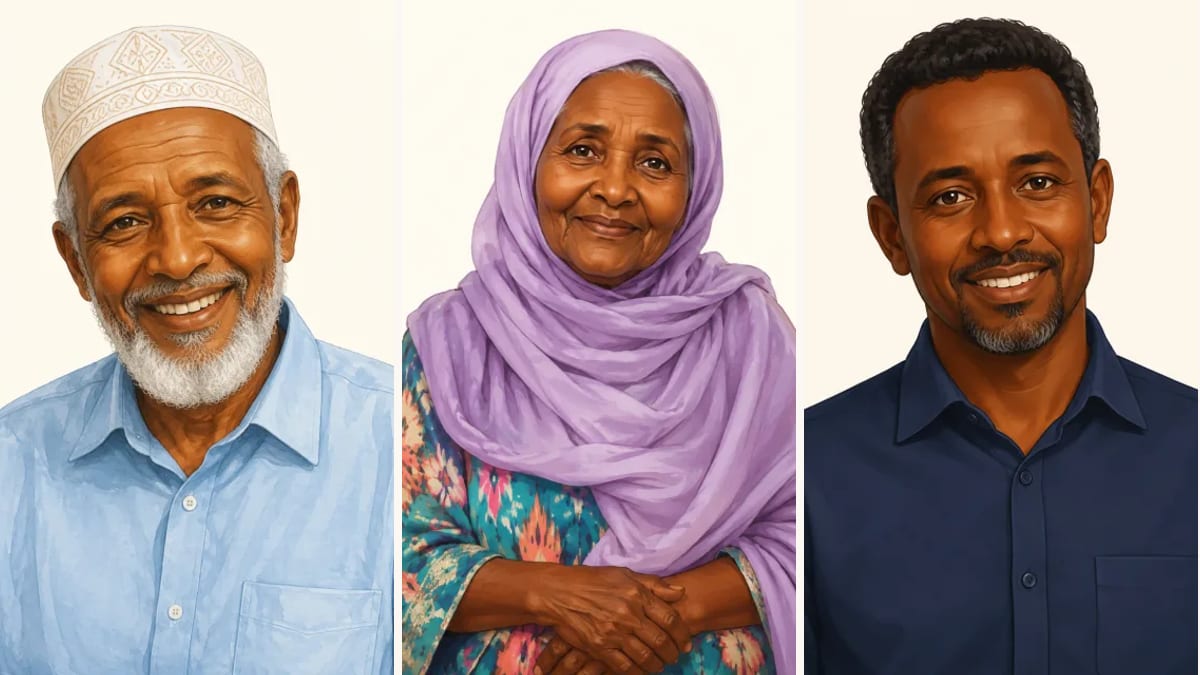
English gets by with “uncle” and “aunt.” Somali wants to know which side of the family you mean, and it has a separate word for each answer. This guide walks through the ten family words every Somali child learns first, the extra words that come up at every gathering, and the habit that puzzles many diaspora children: why your mother calls you hooyo (mother).
The ten words every Somali child learns first
Family words are the first Somali a baby hears and the last a diaspora child forgets. These are the ten in the app’s Family lesson, and you can hear each one recorded by a native speaker on the Family page.
| Somali | English | Exactly who |
|---|---|---|
| Aabo | Father | Also said by a father to his child |
| Hooyo | Mother | Also said by a mother to her child |
| Aboowe / Walaal | Brother | Aboowe is the warm form; walaal means a sibling of either sex |
| Abaayo / Walaal | Sister | Abaayo is the warm form |
| Awoowe | Grandfather | Either side of the family |
| Ayeeyo | Grandmother | Either side of the family |
| Adeer | Uncle | Your father’s brother |
| Abti | Uncle | Your mother’s brother |
| Eedo | Aunt | Your father’s sister |
| Habaryar / Habo | Aunt | Your mother’s sister |
Notice the pattern. Grandparents get one word each, whichever side they are on. Uncles and aunts get two words each, one for the father’s side and one for the mother’s side. That is the whole system, and once you see it you will not mix them up again.
Adeer or abti: which uncle is which
Adeer is your father’s brother. Abti is your mother’s brother. Two short sentences make the rule stick, and both use the pattern X waa Y (X is Y):
- Adeer waa walaalka aabahay. (Adeer is my father’s brother.)
- Abti waa walaalka hooyaday. (Abti is my mother’s brother.)
The distinction matters because the two uncles sit in different places in a Somali family. Your adeer shares your father’s lineage, and in a culture where lineage passes through the father, he is family in the formal sense as well as the everyday one. Your abti belongs to your mother’s people, and in many families the abti is the relaxed, indulgent uncle, though every family has its own version.
Both words are also used politely for men who are not relatives at all. A child who calls an older neighbor adeer is being well brought up, not confused. Each word has its own page with audio: adeer and abti.
Eedo and habaryar: the two aunts
Eedo is your father’s sister. Habaryar is your mother’s sister, and habo is the shorter, softer form you will hear in everyday speech.
- Eedo waa walaasha aabahay. (Eedo is my father’s sister.)
- Habaryar waa walaasha hooyaday. (Habaryar is my mother’s sister.)
Habaryar carries its meaning inside it. The ending yar means small, and the first part is an older word for mother, so the word is usually explained as “little mother.” That is a fair picture of the role: your mother’s sister is the person who steps in as a second mother when your own is busy, away or unwell. Like adeer, eedo is also a respectful way to address an older woman who is not a relative.
Why your mother calls you hooyo
This is the habit that puzzles children growing up in the West. A Somali mother says hooyo to her child. A father says aabo (father) to his. A grandmother calls her grandchild ayeeyo (grandmother), and an uncle calls his nephew adeer. The family word travels in both directions.
There is no English equivalent, and there does not need to be one. Think of it as the relationship speaking rather than the person: when your mother calls you hooyo, she is naming the bond between you, and the same word covers both ends of it. Children pick this up without explanation, which is why a three-year-old in Toronto will happily answer to hooyo and call her mother hooyo in the same breath.
Once you know this, a lot of overheard Somali makes sense. Hooyo, kaalay (mother, come here) may be a child calling a parent or a parent calling a child. Listen for who is speaking.
Siblings, cousins and the wider family
The ten words in the table cover the household. A few more get you through a wedding or an Eid gathering.
- Walaal is a sibling of either sex, and it is also how Somalis address a stranger of their own age: walaal, fadlan (brother or sister, please).
- Ina adeer is a cousin on your father’s side, literally the child of your adeer. The same pattern gives you ina abti, ina eedo and ina habaryar, so Somali tells you exactly how a cousin is related, not just that they are one.
- Wiil is a boy or son and gabar is a girl or daughter.
- Ilmo means a child or children in the sense of offspring, carruur is the everyday word for a group of kids, and cunug is a baby or small child.
- Qoys is the family in the household sense, the people at your table.
- Reer is wider: a family line, a household, or the people of a place, which is why you hear it in phrases like reer Minneapolis for the Somalis of Minneapolis.
The endearments you will hear every day
Somali affection lives in a handful of words that attach to the family terms.
- Macaan means sweet. Hooyo macaan (sweet mother) is what a mother calls her child, and aabo macaan is what a father says; children say them back.
- Macaanto is sweetie, used for girls, and you will hear it constantly at any family gathering.
- Abaayo and aboowe reach beyond the family: friends, cousins and shopkeepers use them the way English speakers use “sis” and “bro.”
- Qalbi means heart, and qalbigayga (my heart) is one of the warmest things you can call a child.
Put them together and you get the sentence every child should have ready for the next video call: Ayeeyo macaan, waan ku jeclahay (sweet grandmother, I love you). If you want more ways to say it, we wrote a whole post on how to say I love you in Somali.
Practicing the words at home
Family words need faces. Put the relatives in front of your child and the words follow.
- Photo game. Open the family album and point: Kani waa adeerkay (this is my adeer), Tani waa eedaday (this is my eedo). Let the child correct you when you get a side wrong, and get one wrong on purpose.
- The call. Before a video call, agree on one line for the relative on the other end, starting with the family word: Subax wanaagsan, abti (good morning, abti).
- The lesson. The Family topic in the app plays each word with a picture, and the Answer quiz for the same topic will show you within a week which relative your child still mixes up.
A child who knows which uncle is adeer and which is abti has learned something no English word can carry. They have also, without knowing it, made an elder’s day.
Frequently asked questions
What is the difference between adeer and abti?
Adeer is your father's brother and abti is your mother's brother. Somali always tells you which side of the family an uncle belongs to, where English uses one word for both.
What does habaryar mean?
Habaryar is your mother's sister. The word contains yar (small) and an older word for mother, so it is often explained as little mother. Habo is the short, affectionate form.
Why does my Somali mother call me hooyo?
Somali family words are used in both directions. A mother calls her child hooyo and a father calls his child aabo as terms of affection, and grandparents do the same with ayeeyo and awoowe.
Try Luuqad with your child tonight
Ten minutes. Real voices. 4.6 stars on the App Store.
Written by Amina Yusuf. Writes about Somali food, culture and family life. Illustrations from the Luuqad app.